Over at Via Negativa, I shared a new videopoem I made on a whim last night. This morning I added some process notes, which led to a few further reflections of possible interest to writers and poetry teachers looking for an easy way to get into videopoeming. First, the video:
I made this videopoem entirely out of found text and footage from American television commercials of the late 1940s and early 50s. I’ve been intrigued by the possibilities of collage in videopoetry ever since I saw what Matt Mullins did with a sermon by Oral Roberts in Our Bodies (A Sinner’s Prayer). This doesn’t rise quite to that level, either technically or conceptually, but it was a fun experiment. Thanks to the Prelinger Archives for the material, all in the public domain.
Process notes: I’ve been downloading compilations of old television commercials for possible use in videos for poems from the new chapbook. While making poetry videos for pre-existing texts is fun, it’s easy to get sidetracked by a wealth of good material, and yesterday I decided to give in to the temptation. I went through one of the compilations, writing down all the good lines in a text document, in order as they appeared so I could re-find them easily. Then I wrote a rough draft with some of the most interesting lines, loaded the source material into Windows Movie Maker and began to cut and paste the snippets containing the lines I’d liked into the order I’d put them in the written draft. Once I had fully assembled the first rough draft of a videopoem, however, I found the words went by rather too quickly. I had the idea of using wordless or nearly wordless segments from a single ad both to give space to the lines of found poetry and to act as a sort of refrain.
At this stage, the working title was “Industry at Work” (taken from a clip that I subsequently removed). However, after a couple of hours of trimming and moving things around, it became clear that the refrain segments just weren’t gelling, and the video overall seemed too scattered and miscellaneous. I began looking at another compilation, and the very first ad in it — a commercial for Budweiser — had lots of wordless footage that I liked. It was only after pasting some of those segments into the draft project that I got the idea of using the first half of Budweiser’s then-slogan, “Where there’s life, there’s Bud,” as title and refrain.
I go into all this (hopefully not too boring) detail simply to show that the process of composition doesn’t differ all that wildly from the way regular poems are made. If I were teaching poetry, this is the sort of thing I’d make beginning students do. Of all the possible approaches to videopoetry, found-poem collage with public-domain (or otherwise free-to-use) footage has the lowest barrier to entry. All you really need is a computer with a DSL or faster connection and whatever video editing software the operating system came with. Moreover, this way of making videopoems comes much closer than the typical poetry video to Tom Konyves’ conception of videopoety as
the Duchampian “assisted readymade”. Consider the recorded image as the readymade; the function of the videopoet is to discover whether there exists something significant, yet still incomplete, a collaborative property beneath the surface of the present moment.
UPDATE (3 August 2015): I’ve found and swapped in the complete film.
*
This is actually a trailer for a short film by Jason Bahling called The Body Show, due out in November. The whole film is essentially a videopoem for “How to Boil an Egg,” which is from Nora Robertson’s unpublished collection Body-Making Cookery — or so I gather from Jason’s notes at Vimeo and a recent post at Nora’s blog:
About five years ago I appeared in a line-up at Borders downtown and read from my then-new collection Body-Making Cookery which is still in progress (cue internal groan). The collection is all recipe poems and explores the associations food has for us, that food is almost never just a way to keep our bodies going, that it reminds us of other things like family, personal biography, history, body image, desire, mythology, religion. When we eat, it’s my belief that we don’t just take the food into our bodies, but all of these associations into the body of our self. I was experimenting with a persona, the housewife, which later morphed into cooking show host gone awry as explored in the short film The Body Show, a collaboration with video artist Jason Bahling to be released in November 2010.
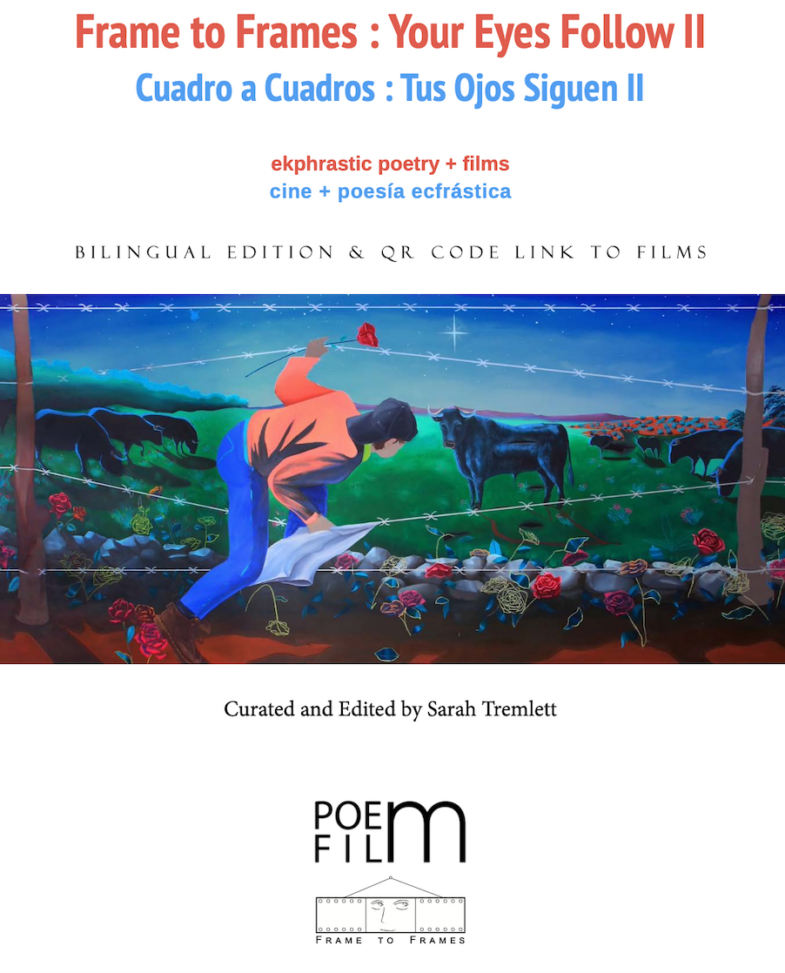
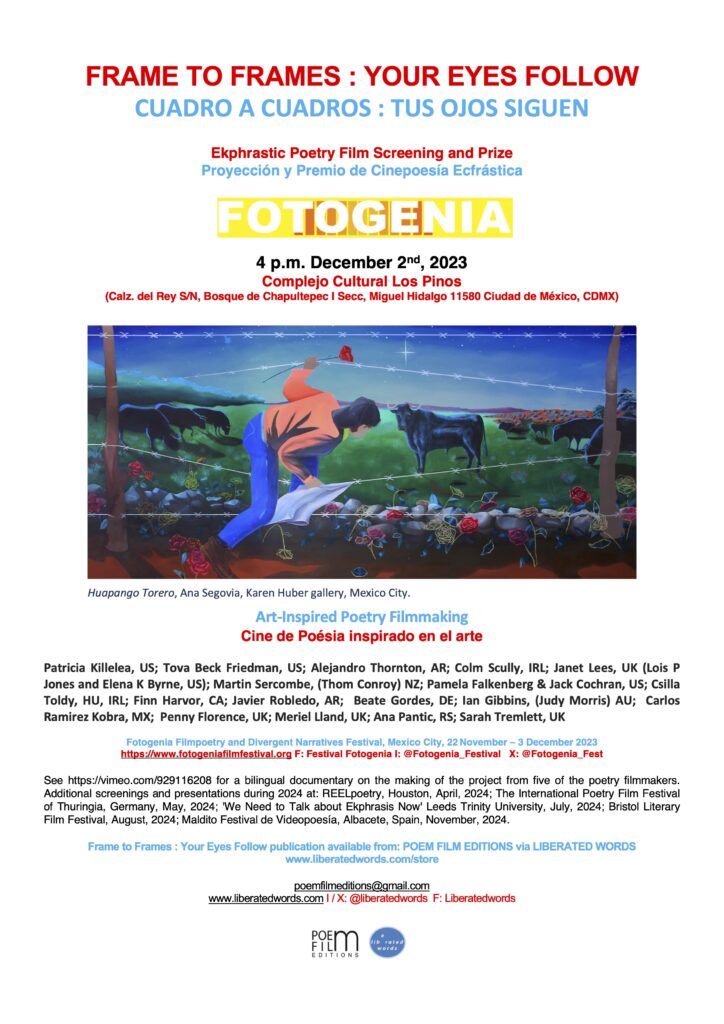
Book Cover for PoemFilm Edition’s new anthology. Cover image features the painting, “Huapango Torero,” by Ana Segovia.
The book is a multimedia, bilingual collection of poems accompanied by QR codes linking to streaming videopoems. Acclaimed poetry filmmaker Csilla Toldy also contributed her expertise to the project as co-director of Poem Film Editions. Featuring the work of 22 poets and filmmakers, these texts and films are mostly inspired by the painting, “Huapango Torero” by contemporary nonbinary Mexican artist Ana Segovia. The book is the first release from PoemFilm Editions, Tremlett’s new publishing platform dedicated to the art of poetry film. Additionally, a Spanish edition of the book (with additional text) is coming out in November, published by Chamán Ediciones, and will be launched at the upcoming MALDITO Videopoetry Festival in Albacete.
Film still from Meriel Lland, “A Love Spell Cast in Petals/Un hechizo de amor hecho con pétalos,” winner of the Frame to Frames II Ekphrastic Poetry Prize (2023)
Tremlett’s Frame to Frames II call for ekphrastic poetryfilms was part of a curated program for the 2023 FOTOGENIA Film Poetry & Divergent Narratives Festival in Mexico City. It was an invitation for the creation of new videopoems with Segovia’s painting serving as the point of inspiration. The painting, vivid in color and emotional tone, is a response to the gendered politics of machismo and the animal welfare concerns of bullfighting practices. Since FOTOGENIA, the collection of videopoems has been traveling the festival circuit, with selections screening at the 9th Weimar Poetry Filmtage in April 2024 and REELpoetry 2023.
There is also a bilingual documentary (made for REELpoetry 2024) on the making of the Frame to Frames II project with five of the videopoem artists. The doc is available for viewing here: https://vimeo.com/929116208.
What makes this collection so unique, besides the QR code-based format, is its emphasis on the ekphrastic videopoem. According to the Poetry Foundation, ekphrasis translates to “description” in Greek. Ekphrastic poetry embodies the “imaginative act of narrating and reflecting on the ‘action’ of a painting or sculpture… the poet may amplify and expand its meaning” (322). The videopoems featured in Frame to Frames : Your Eyes Follow II/Cuadro a Cuadros : Tus Ojos Siguen II (ekphrastic poetry + films/cine + poesía ecfrástica) do just that. Just as Ana Segovia’s painting, “Huapango Torero,” serves as a filmmaker’s portal for new meanings, this anthology is likewise a portal as the reader is encouraged to move seamlessly between the page and streaming online content via QR codes. Not only is this collection truly innovative and collaborative in spirit, taken as a whole, the book reaffirms the contemporary relevance and ever-evolving nature of the ekphrastic as creative incitement and provocation. And while a curated program for a poetry film fest might be ephemeral or inaccessible for those not in attendance, this anthology brings the poetry film festival directly to the reader in a way that hasn’t quite been done before. The Spanish translations by Camilo Bosso also allow for transnational and transcultural dialogues between artists, poets, and filmmakers.
Although this new anthology is a testament to the collaborative spirit that has become the hallmark of the videopoetry community, the project was ultimately spearheaded by poet, filmmaker, and videopoem theorist Sarah Tremlett. Sarah is quite active in the contemporary poetry filmmaking world, known widely for her organization and online platform Liberated Words CIC. Described by Karina Karaeva as a “visual philosopher,” Sarah’s original videopoems have taken top honors at poetry film festivals around the world, and she has also served as jury member and judge for such festivals as REELpoetry and LYRA, among others. She is the author of the seminal study, The Poetics of Poetry Film: Film Poetry, Videopoetry, Lyric Voice, Reflection (2021, Intellect: University of Chicago Press), which includes the voices of over 40 contributors. Described as an encyclopedic and rigorous investigation of the genre, the book is a one-of-a-kind exploration of videopoetry’s formal characteristics framed by the lyric voice. I recently had the opportunity to exchange some thoughts on ekphrastic videopoetry and the new anthology with Sarah, which are excerpted below. Segments of the following interview draw from her scholarship in ThePoetics of Poetry Film as well as her own creative process and years of poetry filmmaking experience.
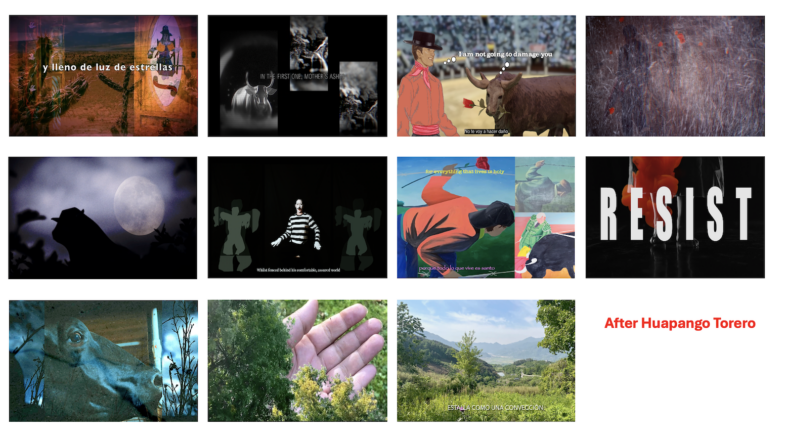
Collage of film stills from Frame to Frames: Your Eyes Follow II
PK: Do you consider the ekphrastic poetryfilms featured in the new anthology to be adaptations of Segovia’s painting? Or are they something more? Why or why not?
ST: Before focusing specifically on ekphrastic poetry films, in their construction, poetry films can exhibit many types of (often app-based) adaptation: where still photographs become animated or coloured and layered with other photographs; a musical score that is remixed; a poem where the lines are altered to fit the film; a montage of many sources combined to create a single film; a drawing that is layered into another time and place. You could argue poetry film is adaptation. Others take a postmodernist stance arguing that all is intertextual, a continuous flow of material reinventing itself.
Ekphrasis itself can be argued to be happening in many poetry films themselves. Every filmmaker who selects a poem by a poet to develop it in their own way can probably be considered to be committing ‘reverse ekphrasis’, though often not deliberately.
The importance of the relationship between the original artist and their respondee in the ekphrastic work sets it apart from other types of adaptation. The central point is that the second artwork is a reply that implies co-existence of perspectives (however abstracted) and also if reimagining, rather than directly representing, extends the original to create a ‘between’ space with its own characteristics. As I write this, I am reminded of the reverse ekphrastic response a filmmaker might make to a poem by another poet, too. Meriel Lland, filmmaker of the winning Frame to Frames film A Love Spell Cast in Petals, also emphasised how she had thoroughly researched the subject, and she felt she was in dialogue with the artist through her response, and I think this is something that is important to remember.
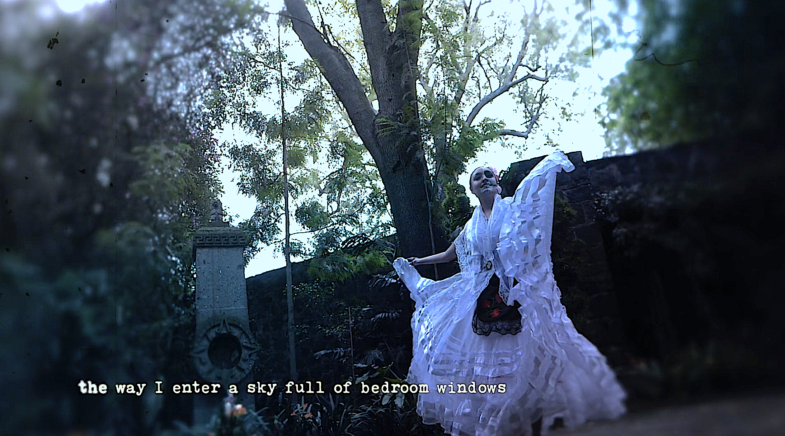
Film still from, “Self Portrait with a Line from Lorca/Autorretrato con una cita de Lorca,” by Janet Lees (filmmaker), based on a poem by Lois P. Jones & Elena K. Byrne
PK: In The Poetics of Poetry Film, you write, “Quite often the poetry film is realized as it is written: poem, then film, with soundscape design completing the picture; but of course, life is rarely this compartmentalized” (40). How does the ekphrastic encourage the liberation from compartmentalization within the creative process? And what are some of the ways in which the poetryfilms in the new anthology “resist the representational” or embody the “the brilliance of intensional, unique symbols” (5)?
ST: I am not sure that I can definitively answer it does, but here are some thoughts. It was you, Patricia, who noted that you wouldn’t have made your ekphrastic poetry film without this ekphrastic prompt and maybe counter intuitively, that is one way to create liberation from a particular personal approach. Since you are also an auteur poetry filmmaker, standing outside your comfort zone and eliciting something unknown from inside could be really important for you to develop your practice
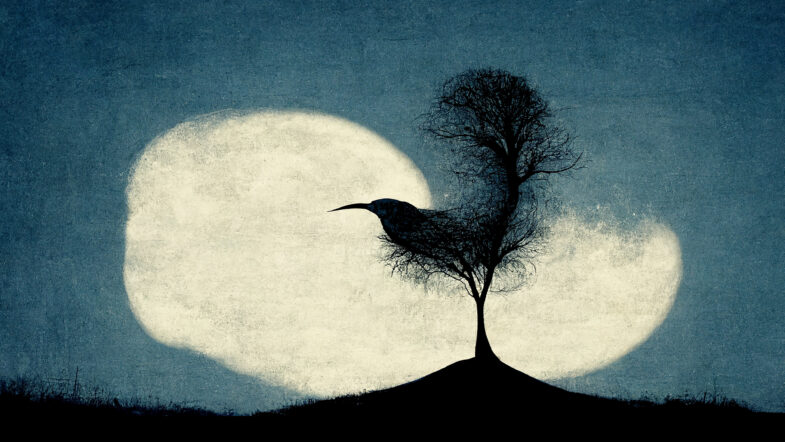
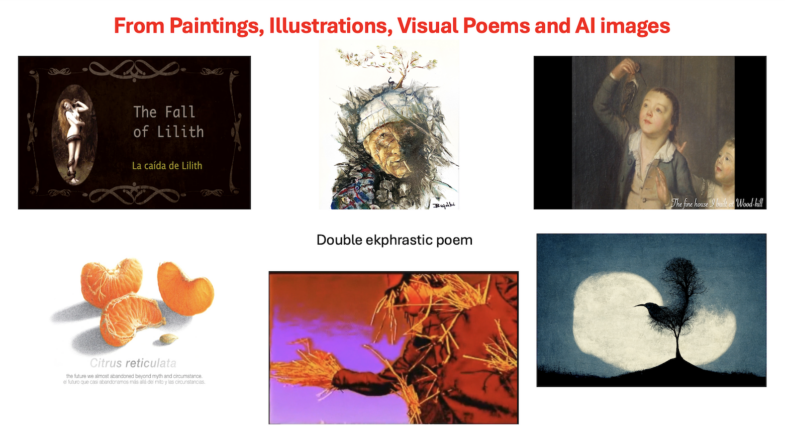
As mentioned, the ekphrastic poem is somehow (to varying degrees) a ‘co-existence of perspectives’ (Cunningham, 2011). If you are a poet who usually collaborates with the same filmmaker, the terms have altered. The original context, voice and subject matter of the source artist have firstly entered the thought processes of the poet, and secondly cannot help but suggest a different type of dialogue between poet and filmmaker, maybe as if a third voice is present, an inclusion of ‘other’? Ultimately, the source artist has to be taken care of in some way, accorded a position, directly or indirectly; by reference or inference. There is also the aspect of the different types of source that might liberate new approaches and thinking: whilst many worked to paintings, Martin Sercombe with poet Thom Conroy chose an AI artwork and Javier Robledo an Argentinian visual poem. So, yes, actually I do think ekphrasis does liberate the artist from a standard practice into unknown territories.
The festival painting (Huapango Torero by non-binary Mexican artist Ana Segovia) is wholly representational, and was selected by over half the artists in the book. This painting where a boy holds a flower up to a bull, is a call to end animal cruelty, machismo and bullfighting. It revises an original work where boys used to go into bulls’ fields at night to practice bullfighting. The highly political subject of animal cruelty though, on the one hand encouraged the visual depiction of animals – the bull – but on the other, an unwillingness to show the gory details, the actual killing, the bloodshed. Filmmakers chose different ways to negotiate this.
Film still from “Sensurious/Sensoriales” by Ian Gibbins (poet/filmmaker) featuring drawings by Judy Morris
In It Ain’t Wot it Seems, Penny Florence adapted direct images from Segovia’s painting that became layered with each other, alongside the bilingual, moving text of the visual poem (also a visual poem on the page).
The winning film, A Love Spell Cast in Petals, by Meriel Lland was many layered and directly representational, including images of bulls, a carving of a bull, and a powerful poem that confronts the subject with depth and emotional strength; a call for change – an end to cruelty to animals.
Janet Lees found the painting too complex to work to, and so based her film on the extraordinary poem ‘Self Portrait with a Line from Lorca’ by Elena K. Byrne and Lois P. Jones which was based on the painting Huapango Torero. Whilst she included some images of toreadors, the main subject matter was a Mexican dancer in slow motion, which the poets viewed as a feminist parallel in rhythm to the toreador’s movements with his cape. This revisioning can be seen as a filmic intensional undoing of the performative machismo of death and killing through celebratory joy and the feminine.
Film still from “Huapango Torero” by Beate Gördes
In Huapango Torero, Jack Cochran and Pamela Falkenberg created an ekphrastic animation of Segovia’s work… as they say “in an intertextual way.” Ideas flow and reinvent each other, a poem is influenced by another poem, and a song, or Ana Segovia’s paintings reappear in different locations and guises in the narrative.
In A New History, your film, Patricia, is about ending cruel stereotypes and a new beginning towards animal-human relationships. You talk to the boy in the painting; and the really meaningful and beautiful line ‘as the hoof takes the hand to show us all another way’ ending with ‘not every dance must end in death … a new history awakens.’ Here the painting is visible in your poem but not in the film at all. It is a reverse ekphrastic transfer via text alone.
Beate Gördes based her images directly on the bull but there was no verbal poem at all.
In Crystal Flower Carlos Ramirez Kobra from Mexico made a film that included images of bulls but associated the poem with the death of his mother and her village home.
Film still from “Night is Paper/La noche es papel,” by Martin Sercombe (filmmaker, poet) and Thom Conroy (poet)
Alejandro Thornton from Argentina focused on the title Huapango Torero and filmed a dancer’s bare feet stamping out the Huapango dance, whilst the words Resist / Exist appear in coloured smoke, but no bull in sight.
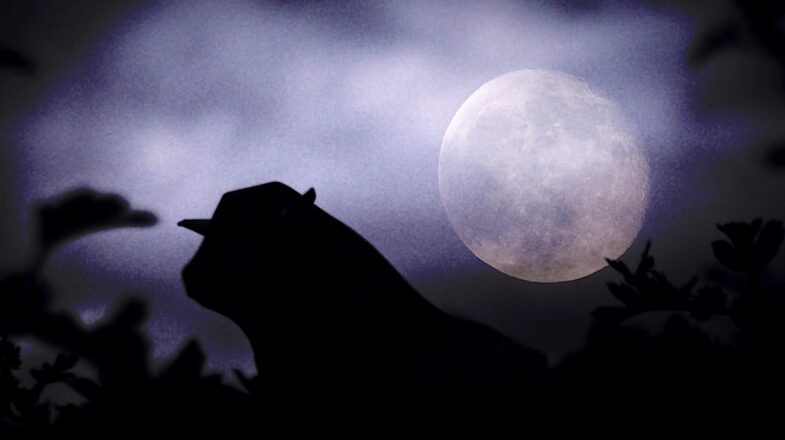
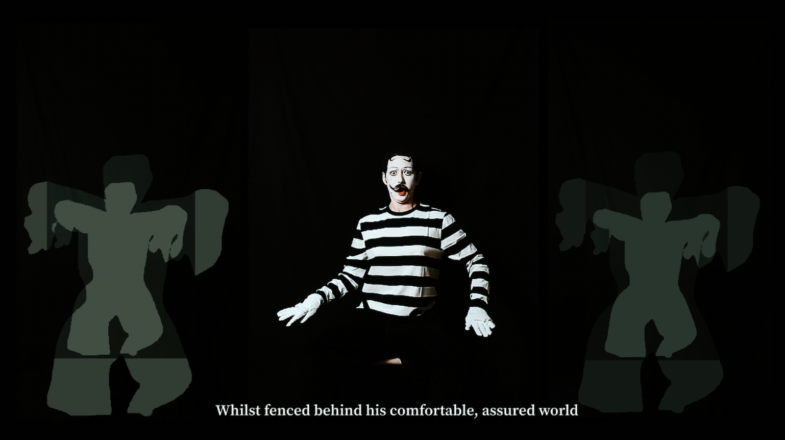
My own performative poetry film includes a mime artist who is both man and bull at one and the same time, to show how little difference there is between us, and how if you taunt a man he will react just the same as a bull. The mime artist was made up with a curly moustache (echoing bull’s horns) and accompanied by silhouettes of the shapes they made in performing, which appear bull-like. The poem is an Italian sonnet in two halves; in the first the man is full of his own importance, and in the second half this is dissolved by the arrival of a fly. The Spanish voiceover and the music tell the narrative very clearly, of the fate of the bull, but we don’t actually see one at all.
Film still from “Bull/Toro” by Sarah Tremlett
Finn Harvor was inspired by Huapango Torero but only in terms of an association between the hot summers in both Mexico and Korea. His film focused on the South Korean landscape and the sun, without referencing the narrative in the painting at all.
Of the artists who chose their own artwork, some were directly representational as in Colm Scully’s Interior Group Portrait of the Penrose Family which was exactly that, and the poem affords a deeper look into their lives through touching on actual events; or Tova Beck Friedman’s The Fall of Lilith painted by the Pre-Raphaelite painter John Collier, where Beck-Friedman examines with a feminist critique a deeply patriarchal approach to narrative
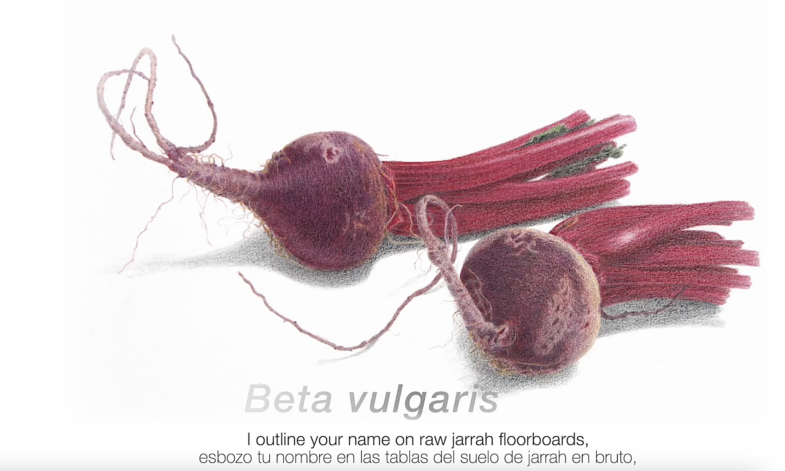
Ian Gibbins responded to Judy Morris’ illustrations of plants, where, after each Latin name of a plant a stream of consciousness description erupts that expands across numerous associations, and I feel is truly intensional.
Csilla Toldy’s poem ‘This Yard’ was a response to another poet and their poem, as she says in a double ekphrastic process.
PK: You have asserted that “Poetry film-making is largely attuned to and in a philosophical dialogue with the world” (323) and can “create radical change for humanity and the planet” (322). How does this new anthology contribute to that philosophical dialogue or create change?
ST: In general, since the rise of digital media and the Internet, the chance for different voices to speak out has emerged, through genres such as poetry film. And these voices have only grown, year by year. Unfortunately for the planet, the environment has become a central issue, and the poetry film community worldwide is voicing its distress. For me, organizing poetry film events and or publishing books means I can share these voices, and particularly encourage a diverse lens.
Collage of film stills from Frame to Frames: Your Eyes Follow II
PK: What were some of the unique challenges or revelations that arose during the completion of this first publication from PoemFilm Imprints?
ST: I knew that asking artists to create work that tries to offer ideas for political change would be difficult, especially coming from left field, but I feel that the responses were extraordinary, brave and memorable. The question is – how to create an artwork that speaks to us both politically but also creatively, reflectively and aesthetically without making us turn away, or reject the work for other reasons, too. Every artist in this collection achieved that very difficult double act, and I applaud everyone who took part.
I have worked in publishing on and off for many years, so I knew what I had to do in terms of production, editing, proofreading, paper selection etc. etc., and I have been curating poetry film screenings since 2012, so in general not many areas were a surprise. However, I specifically wanted it to be bilingual, to include Spanish readers, and to show the comparative musicality – euphonious or sonic patterning – rhythm, syntax etc. between the two languages. I am learning Spanish, and I had worked with translator Camilo Bosso before, and through him I discovered a lot about the language and honing the exact translations in the process. This was time-consuming but has been richly rewarding!
Maybe the biggest revelation is that although I kept thinking it was taking too long to produce, since I had announced it in December in Mexico, the fact that it only took six months, for a 116-page, bilingual anthology with links to films was amazing. If you look at academic publishers and their long schedules I feel really pleased about that.
Csilla Toldy, my co-director also has been very helpful and given great publishing advice and a second pair of eyes, which are really needed at the start of a company.
In terms of the aims of Poem Film editions, it was also essential to source an environmentally aware printer, (for the book and even bookmark); it is important to me that the books follow through in my eco credentials, and environmental beliefs.
Film still from “Crystal Flower/Flor de cristal” by Carlos Ramírez Kobra
What has also been wonderful is the reception it has had, both from contributors and readers. It is especially gratifying to hear praise first hand, as I travel around on my tour presenting the book: so far FOTOGENIA (Mexico city), REELpoetry (Houston online), Weimar (Germany), and Leeds Trinity ekphrastic symposium (UK). However, I really would like more of the contributors to come along, although many aren’t in the UK. The next one is at Bristol Literary Film Festival on October 27th.
PK: Is there anything else you’d like to share about ekphrastic videopoetry, your own creative process, or any other comments or contributions by filmmakers featured in the book?
ST: In terms of my own practice, I personally have worked with ekphrastic poetry films before, as in Villanelle for Elizabeth not Ophelia (based on the painting Ophelia by Dante Gabriel Rossetti) which takes a feminist stance against the position of the model and abuse of power, and there are others that are upcoming. My latest film Flight which is from the commissioned poetry (with images) collection The Unexhibited, due later this year, includes some fragments of my early Neo-Expressionist paintings, alongside those of the Cornish painter Peter Lanyon. The film centres on drone footage of the coast of Cornwall, and this is also a reference to Lanyon who in his later years flew a glider and made glider paintings (actually dying from a gliding accident). It also includes a reference to an ekphrastic poem I wrote ‘The (Last) Green Mile’ (based on one of his other works) in Transitional anthology by the Otter Gallery workshops, Chichester University, 2017.
Film still from “After Huapango Torero/Según el caudro Huapango Torero” by Finn Harvor
I would finally like to add something of the reality of the working process of Bull, my own poetry film response to Huapango Torero which gives an insight into a dramatic, scripted (though without dialogue) performative poetry film. I conceived the narrative and concept (and lighting), which was interpreted by my daughter Hatti aka XaiLA who is a performance and makeup/ special effects artist in LA. My other daughter Georgie directed onsite, with a script (sent by WhatsApp) by myself. Hatti has never taken on this role before, and together they interpreted what I wanted and then some, as there was the added factor of a subtle, strangely dark humour brought to the performance. It was also determined by the clothes and makeup and the small space to film in (a small studio apartment), which in some ways also added to the sense of being trapped, whilst feeling like an experimental, cabaret-style venue. I found the Spanish band Lapso Producciones whose evocative, bitter-sweet cabaret-style music fitted both parts of the Italian sonnet structure and the Spanish voiceover artist Helena Amado brought a subtle sense of delightful irony to the narrative to complete the picture. I think this film shows how each person, each creative practitioner contributed an important part of the final result.
Film still from “Huapango Torero” by Jack Cochran and Pamela Falkenberg
All the contributors have been wonderful, and supportive and view it as a unique and timely project that they are proud to be part of, so I can’t really ask for more than that. It was a leap of faith, a leap in the dark and I really had no idea that it would achieve what it has, when I think back to last summer when I began requesting films. At that stage a book hadn’t even been thought of. Looking back, I think it was the quality of the films and the poetry that inspired me to expand the concept from a prize and screening to an intermedial project. I have been told it is a first in the field and if so, I am extremely happy!
As Janet Lees mentioned in the video documentary on Frame to Frames, in poetry films the poem often passes you by, but here you can stop and pause and go back to the poems and read them in either language at your leisure. So, there is not only the comparison between the painting and films but also the comparison between the poems on the page in English and Spanish and also the poems as they appear in the films.
What I would like to say is that this project is also very different in that the ‘book’ is more than simply a book. It is a central hub with bilingual poems and explanatory synopses, and the poetry films are extensions of that, if you like, via QR link. It affords a different type of (varying chronologies) audience experience for the reader/viewer.
PK: Do you plan on organizing additional ekphrastic videopoem series in the future?
ST: You ask about more Frame to Frames events. Readers of Moving Poems can always submit ekphrastic poetry films to me. I will build a collection and it could serve for the next edition which will be down the line.
For press, further details regarding readings and screenings, or if you wish to submit ekphrastic poetry films for future events see poemfilmeditions@gmail.com.
The Zebra International Poetry Film Festival took place from 12 to 15 October at Haus für Poesie and Kino in der Kulturbrauerei in Berlin, Germany. A jury of Rosa Maria Hopp (editorial director MDR), Federico Italiano (poet) and Maria Mohr (filmmaker and film educator) selected three films for awards from the shortlist of 25 poetry films selected for the international competition. The festival attracts around 1,200 entries from over 90 countries.
The 2023 ZEBRA Prize for the Best International Poetry Film went to Fitzgerald & Rimini – D Frou Bovary de Porrentruy by Yannick Mosimann from Switzerland, with a poem by Ariane von Graffenried.
In their statement, the jury said: “Hemmed in by the mountains, this film not only features a protagonist trapped in the dreariness of daily life but also an image frozen in time—sometimes the 16 mm image is torn, sometimes doubled. And then, there’s that battered post rock over and over. It’s a perfect whirlwind of cinematic elements, interwoven with the three languages of the extraordinary poem that fuels them. And in between, there’s that “disturbing woman.” Hardly any phrase encapsulates this film as well as, “Mrs. Bovary from Porrentruy isn’t who she wants to be / Her needs are big, her life’s petit.””
The Goethe Film Award – Borders went to Kin ma belle by Junior Mozese from the Democratic Republic of the Congo, who is also author of the poem the film is based on.nnhttps://vimeo.com/806089631nnThe jury’s statement: “There are no protagonists in this film, just a city that reveals itself through its contradictions and weaknesses. Singing its praises, the lyrical voice observes the metropolis from unexpected angles, from the sidewalks, from the depths of landfills, in the cracks of life—between healing and exclusion. The film is a vibrant love song to the wayside. This year’s Goethe Film Award goes to an entry that utilizes documentary techniques: “Kin ma belle” by Junior Mozese.”
The 2023 Ritter Sport Film Award went to Legs by Jennifer Still, Christine Fellows and Chantel Mierau from Canada, based on a poem by Jennifer Still.nThe jury’s statement:“Legs create a gap that connects several generations of women. Between a kid’s birthday party and swimming pools, the bodies—shells—cultivate a playful life of their own. The film distinguishes itself through its unique object creations and an extraordinary timing that often borders on the absurd. Colorful mourning in glitter. What’s left when the body’s gone? Stockings.”
Two special mentions were given by the jury.
The first one is a special mention of the Goethe Film Award for Satane Sefid by Shiva Sadegh Asadi from Iran, both director and author of the poem the film is based on:“How should one narrate a border crossing that affects the most intimate sphere? In tightly framed, claustrophobic images, the Iranian filmmaker Shiva Sadegh Asadi succeeds in showing that the private is always political. Woman, life, freedom!”
The second one is a special mention of the Ritter Sport Film Award for Meanwhile, somewhere in the state of Colorado by the Italian Gloria Regonesi, based on a poem by Simon Armitage:“Sometimes, the greatest art lies in visualizing the absolute. Through the simplicity of its visual language, this film is able to emphasize the power of poet Simon Armitage’s words without ever overshadowing them. Unpretentious and free of cliches.”
The ZEBRino Poetry Film Festival audience also awarded an audience award. The 2023 ZEBRino Award for the Best Poetry Film for children and youth was awarded to Abri by Julie Daravan Chea from France, based on a poem by Esther Granek.
A special mention was given to the film Swallows love by Mariya Onishckenko from the Ukraine, based on the Volkslied Shum.
Autumn is a busy time in the poetry film world, especially when the biannual Vienna Poetry Film Festival, AKA Art Visuals & Poetry Filmfestival, is happening. It’ll be held on November 14-17 this year. Here’s the full program.
Highlights of this 10th anniversary edition of the festival include a poetry film competition based on the festival poem “la luna” by Viennese poet Manfred Chobot, with seven selections from around the world, and of course the main competition program, which is split into two sessions: one for Austrian films, and the other for German-language films from Germany and Switzerland.
A few days after that program appeared online, the Midwest Poetry Video Fest organizers uploaded detailed programs for their two-day event in Wisconsin, USA:
There will be two evenings of live Poet + Filmmaker performance followed by film screenings on October 14th and October 15th at ALL in Madison, WI and at Woodland Pattern in Milwaukee, WI. Each evening’s screening will be unique and will include a selection of works from the open call alongside works by artists especially invited by the Curatorial Team.
Each date links to a program, including thumbnails and a description of each of the 29 videopoems.
And then today the big dog, Berlin’s ZEBRA festival, announced its program. The English-language version is here, using what looks to be a repurposed URL from 2022. Each time it has a different national focus, and in 2023 that’s going to be Italy:
With selected poetry films from this year’s submissions, as well as the best Italian films of the past years, ZEBRA will present various facets of Italy film and poetry scene. Landscape, love, culture, tradition, and conflict are just a few of the themes. Films in this program are based on poems by Dante Alighieri, Gioacchino Belli, Elena Chiesa, John Giorno, Giacomo Leopardi, Milena Tipaldo oder Lello Voce.
About 1,200 entries from over 90 countries were submitted to 2023’s ZEBRA Poetry Film Festival. A program committee nominated 25 of them for the international competition.
The three-member international jury will award the following prizes this year: the “ZEBRA Prize for the Best Poetry Film,” donated by the House of Poetry, the “Goethe Film Prize – Borders,” donated by the Goethe-Institut, and the “Ritter Sport Film Prize,” donated by Alfred Ritter GmbH & Co KG.
If any Moving Poems readers are planning to attend these events, we’d love to hear they went. Feel free to send in any reports or observations you may have.
Dancing, music and singing have been key aspects of my life over the decades since my childhood, and I am naturally drawn to them as ways of exploring and expressing poetry in film.
This collection of ten is made up of pieces that move me in different ways. The order I have given them is not a ranking, but simply designed to be seen and heard in a flow from start to end.
*
ODE TO MY BITCHFACE Film-maker: Tim Davis Writer & Voice: Olivia Gatwood Choreography & Performance: Rebecca Björling & Rebecca Rosier USA/Sweden
A marvelous response in dance to a powerful poem, Ode To My Bitchface was written by Olivia Gatwood in the US, who also voices the piece. The rhythm of the film, directed by Tim Davis, follows closely the choreography and dancing by Swedish artists Rebecca Björling and Rebecca Rosier. The dance is timed to the rhythms of phrases in the poem, and the movements literally matched to the meanings of the words. The fast-paced precision is exhilarating. The absence of music highlights instead the strength of the words, voice and bodies in motion. The poem can be read on the page here.
*
DEAF BROWN GURL (LA MORENA SORDA) Film-maker, Writer & Performer: Sabina England Voice & Sound Design: Micropixie Music: Om/Off (Paco Seren and Pablo Alvarez) India/UK/USA
Sabina England makes beautiful expressive dance from American Sign Language in this film about identity. In her own words…
It’s based on a poem of the same name that I wrote, which I performed in San Francisco, Washington DC and at Pride Fest. It’s about exploring my identity as a deaf brown girl growing up feeling isolated, lonely and different, and learning to accept who I was and coming to love myself.
I shot beautiful scenes of various places all over Bihar, including the ancient Buddhist site at Mahabodi Temple in Bodh Gaya, Bihar. I also went to a deaf girls school in Patna and I was so proud and impressed with these little girls because they could write in Hindi, English, and they were also fluent in Indian Sign Language! (source)
*
MORE THAN ONE Film-maker & Writer: Amang Composer & Singer: Lo Sirong Taiwan
A musical videopoem from Taiwan, More Than One features the exquisite voice of Lo Sirong singing a poem by the writer known as Amang, who is also the film-maker. The image streams in Amang’s videos are distinctly poetic in themselves, with a quality of mystery going far beyond literal illustration of the words. The wonderful music and voice of Lo Sirong features in some videos by other film-makers here. More videos from Amang are here.
*
BETWEEN BEFORE AND AFTER /WAR/ Film-makers: Marichka Lukianchuk & Elena Baronnikova Writer: Marichka Lukianchuk Dancer: Angelina Andriushina Music: DakhaBrakha Ukraine
This profoundly moving video from Marichka Lukianchuk and Elena Baronnikova features a brief dance sequence as part of an ensemble of poetic image and sound. The subject is the experience of living in Ukraine at this time of war. I find unimaginable serenity and bravery in this film. The simple beauty of the dance performed by Angelina Andriushina is an important part of the vulnerability and hope expressed. The music that further graces the piece is by DakhaBrakha. Marichka Lukianchuk writes eloquently and at more length about the film here.
*
SHADOWS Film-maker: Tal Rosner Writer: Langston Hughes Composer: Lior Rosner Singer: Janai Brugger Dancers: Cameron McMillan & Fiona Merz USA
The poem Shadows by Langston Hughes (1901-1967) is expressed in this film in exquisite music by Lior Rosner, so beautifully sung by Janai Brugger. Visually it begins as an abstract animation that graphically responds to the music, later morphing into fragmented moments of dance performed by Cameron McMillan and Fiona Merz. The film-maker bringing all elements together is Tal Rosner. The poem can be read on the page at poets.org. More information and stills can be found at Tal Rosner’s website.
*
HALLOWEEN Film-maker: Marc Neys Writer & Voice: Hugo Claus Choreography & Performance: Nadia Vadori-Gauthier Belgium/France
Central to this haunting film by influential Belgian artist Marc Neys, is an extraordinary dance piece created and performed by Nadia Vadori-Gauthier, artistic director of the French dance company Le Prix de l’essence. The piece for this film is from her amazing project titled One minute of dance a day. For this she has posted inventive short dance videos every single day since 2015. Marc Neys has been a prolific maker of distinctive videopoetry for over a decade. His slow motion treatment of the dance, and his selection of moments from it are mesmerising. The dark ambient music is also his creation. The poem is read in Dutch by its well-known Flemish author, Hugo Claus (1929-2008), in a recording from the German Lyrikline website, where it can be read in a number of different translations.
Congolese dancer Aïpeur Foundou is a graceful and compelling presence in this film, a collaboration between director Matthieu Maunier-Rossi and poet Ronan Cheneau, both in France. The poem is a reverie about the freedom that can be found within, in simple experiences and places, when it cannot be found in the wider world. The film-maker writes about the process of making the piece here.
*
ROLLING FRAMES Film-maker: Katie Garrett Writer: Ella Jane Chappell Voices: Katie Garrett & Nicholas Herrmann Choreography: Anna-Lise Marie Hearn Performers: Laura Boulter, KJ Clarke-Davis, Lydia Costello, Jennifer Jones, Nathalia Lillehagen & Ella Mackinder UK/Norway
Film-maker Katie Garrett and writer Ella Jane Chappell, both in the UK, teamed up with Norwegian choreographer Anna-Lise Marie Hearn to create this affecting dance film that won the Southbank Poetry Film Festival in 2014. From the film’s notes at Vimeo:
At the heart of Rolling Frames are a series of shifting voices and characters that inhabit three very different relationships. These relationships are linked by the role that dependency plays in each. To some extent, every relationship involves a yielding of independence. The poem dissects this manner of yielding: the manifestation of greed in desire, the vulnerability in love, the loneliness in lust. The physicality and inner rhythms of the words are translated once over by the expressive movements of dance, and once again through the gaze of the camera’s eyes.
*
BECAUSE GODDESS IS NEVER ENOUGH Film-maker: Jane Glennie Writer: Rosie Garland Voice: Rosie Garland & Alison Glennie Dancer: Natasha Jervis UK
This film about a dancer draws inspiration from the life of Austrian-born Tilly Losch (1903-1975), also a choreographer, actor and painter. It is a collaboration between film-maker Jane Glennie and writer/performer Rosie Garland, both award-winning artists in the UK. The subject is the representation of women artists in history, especially the ways their stories have been footnoted in relation to famous men. Jane Glennie animates thousands of her photographs in a rapid stream, meticulously layered with contrasting rhythms that underscore voice and text. Rosie Garland’s expressive narration of her own poem is highly effective, alternating with that of Alison Glennie, equally as affecting in the sections that evoke Losch speaking for herself. Jane Glennie writes about the process of making the film here.
*
HUMAN CONDITION Film-maker: Mark Wilkinson Writer and Performer: Rich Ferguson Singer: Stella Ademiluyi USA
Compared to most poetry videos, Human Condition is an action-packed blockbuster. It was written and performed by Rich Ferguson, the beat poet laureate of California 2020-2022. For this satirical, sometimes scathing, yet ultimately uplifting musical, he teamed up with director Mark Wilkinson and an ensemble of performers and musicians, including singer Stella Ademiluyi and James Morrison from the cast of Twin Peaks. The text of the poem is posted at YouTube in the video notes.
Still image: Alfonso Fernández Sánchez in Borne – written and directed by James E. Kenward
Lockdown and pandemic experiences have thoroughly honed and expanded Ó Bhéal’s experience of presenting events online (helped by their growing collection of technical kit that they have been fortunate to acquire over the last few years). The 10th International Poetry-Film Competition, and the wider Winter Warmer Festival it is now part of, was fully hybrid with all events running in-person at the beautiful Nano Nagle Place in Cork (Ireland), and simultaneously live-streamed. All events are available to watch indefinitely online.
The competition selected 30 films shown in two screenings. I left each screening with excitement, and a variety of films and filmmakers that I wanted to watch again or know more about. These are some of my personal highlights:
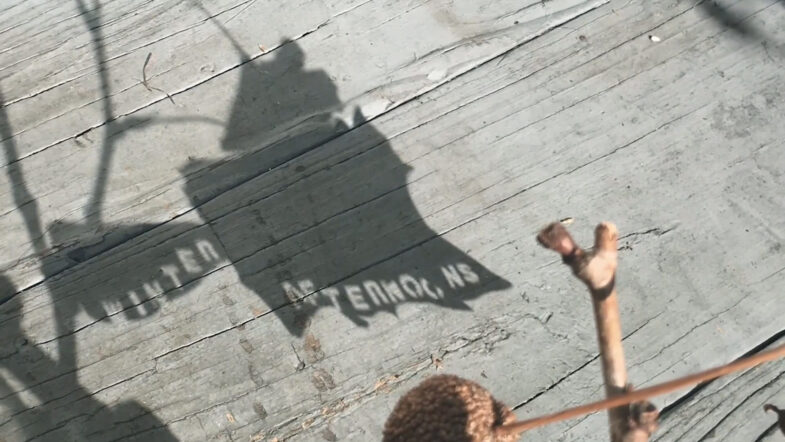
Selkie (Director Marry Waterson) had an unusual approach to image repetition. Rockin’ Bus Driver (Directors Mary Tighe and Cormac Culkeen) had a very satisfying, meaty voice in the soundtrack and a simple but effective graphic treatment of the visual material, while Borne by James E. Kenward had an incredible delivery of the voice – the pace and the pairing with the music were brilliant. The success of this partnership is perhaps explained by a YouTube of the recording session where you can watch James performing the text alongside the pianist. A brilliant way to create the soundtrack if feasible for a project. I particularly liked the lettering in There’s a Certain Slant of light (Director Susan McCann) – text cut from leaves and cast by shadows, and the words accompanied by just music. And as a final contrast to the varied treatments of sound in the selected films, there was Janet Lees’ powerful but silent film Descent.
Still image: Susan McCann – There’s a Certain Slant of light )
The effort involved in putting together a festival can never be underestimated, and Paul Casey and Colm Scully have done a brilliant job of making the selections as well as organising the event and keeping everything running smoothly and technically well throughout the day. My only desire as an in-person attendee is to be able to have more awareness of who in the room were filmmakers (name badges, stickers, or something more imaginative perhaps?) and little bit more time specifically programmed in to be able to meet and chat to them. Filmmakers were introduced and invited to stand at the end of the screening, but it is difficult to register everyone’s face (especially in a semi-dark room) and I think attendees do need the reward of interaction to make the in-person experience special. I noticed that the finalists of the All-Ireland Poetry Slam later in the day had the opportunity for a group photograph, and I think this would be an appreciated chance for the film competition too, for those that were there on the day.
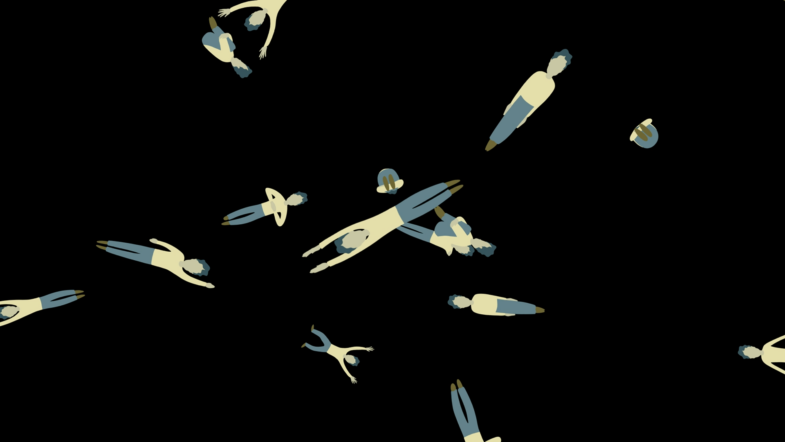
Still image: Jelle Meys – La luna asoma
The winner of the competition was announced as La luna asoma (The moon appears), an animation by Jelle Meys of a poem by Federico García Lorca. I contacted Jelle to congratulate him on his win and ask him a few questions …
ME: The poem is read in Spanish, was subtitled in English, and you are Belgian. How fluent are you in Spanish? Were you aware of Federico García Lorca’s poem in a translation in your mother tongue, or in English? Which language version of the poem did you go to in your mind when you were thinking about the imagery for your animation?
JELLE: My mother tongue is Dutch, as I’m from the Flemish part of Belgium. When I decided to animate a poem, as a kind of practice, I hadn’t chosen a specific poem yet. So I just browsed through the poetry collections I own. One of those is an anthology of Federico García Lorca, with both the original poems in Spanish and their Dutch translations on the opposite pages. It was necessary to have the Dutch translation to ‘get the meaning’ (which is obviously relative with such metaphoric poetry), but I also wanted to stay true to the rhythm and the sounds of the original Spanish version. I can grasp quite a bit of Spanish, especially when written, because of my knowledge of French.
ME: In a YouTube video I saw, where you talk about your work (for another festival I think?), you mention that you are relatively new to animation but you have long been an illustrator … the sequence with the sea and the swimmers was just beautiful. Did you have a clear idea of how you wanted the movement of the bodies to happen before you began the animation?
JELLE: That YouTube talk was indeed for another festival, in Mumbai. Before getting into the animation, I drew a simple storyboard. So I did have some idea of what I wanted it to look like. But in the making of this film I learned a lot about animating, technically, which altered and influenced the final look. The swimmers sequence was a particularly tough one, because for that part I did have a clear vision in mind, and I didn’t want to compromise on it.
ME: What was your thought process on the colour palette that you chose?
JELLE: The colour palette was also very clear to me, pretty much right from the start. I’ve always loved the combination of brown and blue and considered it fitting for the somewhat melancholic tone of the poem. I also thought that a limited colour palette wouldn’t distract the viewer too much from the actual poem.
ME: The music is a perfect accompaniment. Was this pre-existing and if so, how difficult was it to find? Or was the music written or adapted for the film?
JELLE: My cousin, Michiel De Malsche, happens to be a composer and sound artist. He used samples and recordings from music workshops he had done in the past (hence why he didn’t ask for his name in the credits) and puzzled them together into a mesmerizing soundscape, which perfectly blends with that deep and warm voice of Joaquin Muñoz Benitez (a Spanish man living in Gent, Belgium).
***
Biography:Jelle Meys lives and works in Sint-Niklaas, Belgium. He studied Illustration and Graphic Design at School of Arts Ghent (2005-2009), where he also got his Teacher’s degree (2010). He currently teaches graphic design and illustration in high school, and works as a freelance illustrator, graphic designer and visual artist. He started taking film and animation classes in 2017, and has been infected with the animation bug ever since.
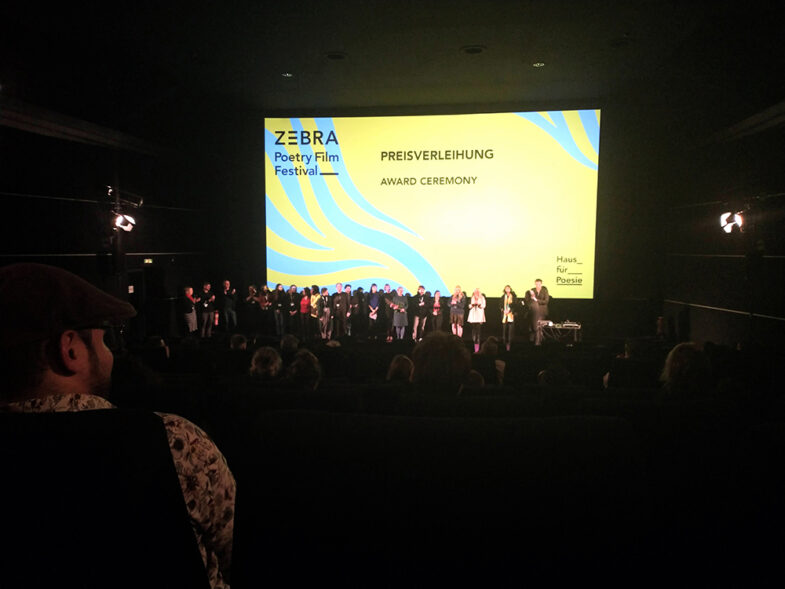
Award ceremony – Zebra Poetry Film Festival 2022. Photo: Jane Glennie
Four days of events, readings and film screenings in one of the cultural hearts of Berlin was completed with the awards ceremony on Sunday 6 November 2022. In the fabulous venue of the Kino in der Kulturbrauerei, filmmakers and poets attended ZEBRA from far and wide – from Brazil to Ukraine by way of Ireland, UK and Switzerland to name but a few.
A wide-ranging and well-attended festival dedicated to poetry film is a marvelous thing. ZEBRA is the largest and longest-running festival of its kind, and the hosts were delighted to be fully in-person and without restrictions again. The event is welcoming, friendly and in a brilliant venue in a great part of a great city.
Film is often the first impression we get of a city in the world, and being from the UK, it took me a couple of days to get over the feeling of being in every Cold War spy movie I’ve ever seen that has passed through East Berlin. But I was lucky enough to be able to attend ZEBRA throughout the four days and soon felt relaxed and at home in this exciting, culturally rich city. It’s not physically possible to see all that ZEBRA has to offer because there are often events or screenings that take place simultaneously, but the film selection I enjoyed included animations, documentaries, spoken word films, and sign language poetry film. The programme committee want to represent the world in the films they choose for the International Competition, as well as a range of genres within films connected by the common thread of poetry or a poetic approach. They chose to have a focus on Ukraine with both films and poetry readings, and a retrospective of Maya Deren (born in Kyiv), but beyond the dreadful situation faced by Ukrainians, ZEBRA seem keen to use their platform to screen films that have pertinent and important messages to convey.
In the programme, the new director of ZEBRA, Katharina Schultens, said:
“Poetry and poetry films do not have a lot in common with the escapism of the entertainment industry and the consolation its products may offer. They reach much further than that. Yes, they can offer us comfort, too, but while doing so, they also pose the difficult questions we have to face… [such as] war and displacement … exclusion in societies … climate catastrophe…”
At this point in the week afterwards, reflecting on the films I have seen and the films I have missed, or been forced to miss because of simultaneous programming – this is where an online component would be hugely valuable, and I urge ZEBRA and all other festivals to consider the approach taken by the Women Over 50 Film Festival (WOFFF) in Lewes (UK) this year. WOFFF took place in a hybrid format. All films could be watched in the online festival leading up to the in-person event. But the really valuable bit is that attendees of the in-person event were offered a voucher to watch more of the films throughout the week AFTER the in-person event. Talking to people during the in-person event, and through the connections you make, you meet or discover writers and filmmakers whose work you have missed, hear recommendations for someone else’s favourite film, see a film of a type that you didn’t know you were going to love and you want to explore more of, or recall something that sticks in your mind and you want to watch again to appreciate fully. Or simply your appetite has been awakened for the very first time and you want to see more than you thought you would …
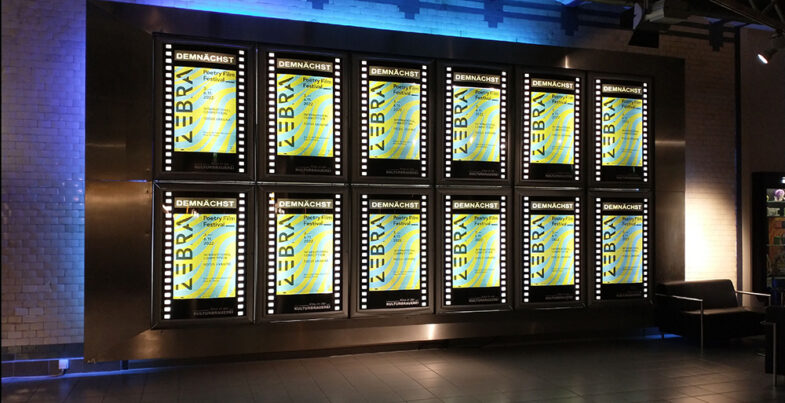
Kino in der Kulturbrauerei, Zebra Poetry Film Festival 2022. Photo: Jane Glennie.
The winners of Zebra 2022 seem to reflect an overall philosophy of championing weighty subject matter. Or perhaps they reflect an understandable mood of seriousness in the world. (The list of winners and judges’ comments are available on the ZEBRA website and in their press release.) Personally, I was disappointed by the choice of both Black. British. Muslim. Other. and Terra Dei Padri (Fathers’ Land). While each had a very strong story to tell, one through a very immediate approach in the poet’s performance and direction, and the other through the use of archive images, I did not think either was a great example of their type. Far stronger in the use of language, image and filmmaking technique was the film given a special mention, Zyclus (Cycle).
The strongest film receiving an award was Imaginings. Written and performed by a collective of deaf poets, the film is poetry in sign language. The direction of the film by Anja Hiddinga and the energy given to it by the poet performers themselves made this an extremely compelling film to watch. I give a personal special mention to the typographic choices made for the subtitling. The words were placed over the centre of the chest of each performer as they signed. This meant that you did not need to take your eyes away from their hands and their signing. At times the type could be slightly difficult to read because it bobbed about as the poet’s body moved, but this added to the physicality of the language because their bodies moved more in, for example, moments of frustration.
The most interesting poetry film I saw was one of the selected three best interpretations of the festival poem Anderkat by Georg Leß. The poem is fascinating but very oblique. I personally found it impenetrable when I tried to imagine a treatment. At the Festival Poem event, when Georg Leß was introduced and he talked about his poem, his fascination and work with horror films came to light which then made a lot of sense in relation to his writing. I could let myself off the hook a little because I can rarely find a connection with horror in film. One of the filmmakers talked about expressing the uncanny and I think this was the key to this poem. The longlisted films shown before the three best failed to do this and, as a result, felt very unsatisfactory and weak in their choice of images. But I thought the film by Beate Gördes was stunning. Notable because it used no words, only very peculiar, uncanny images, it is one of the films I really want to watch several times over to appreciate its subtleties.
Two very enjoyable films in the event were documentaries. Spatzen und Spaziergänge (Sparrows and Strolls) was the beautifully shot and framed film by Maria Mohr with the poet Marko Pogačar, and the other was The Last Cuckoo by Mark Chaudoir about the poet Dennis Gould which managed to capture the personality of the poet’s life in a hugely engaging way. Also pleasing was the community project from Dublin, Dance till Dán which fused choreography with collectively created poetry.
Overall however, I would have liked to have seen more films that interpreted poems of the very highest quality with visual results that are more intrinsically a fused filmic/poetic experience in themselves than they are illustrative or performative. Perhaps those are the ones I happened to miss? On that note, I reiterate, please ZEBRA, do consider an online offering that extends after the in-person event.
Body, remember not only how much you were loved
not only the beds you lay on.
but also those desires glowing openly
in eyes that looked at you,
trembling for you in voices—
only some chance obstacle frustrated them.
Now that it’s all finally in the past,
it seems almost as if you gave yourself
to those desires too—how they glowed,
remember, in eyes that looked at you,
remember, body, how they trembled for you in those voices.
translation by George Barbanis
Dancer/choreographer Konstantina Ntinapogia directs this collaborative “embodiment” of a poem by the great 20th-century Greek poet Cavafy. Since the English translation is not included in subtitles, only in the Vimeo description, viewers without Greek may, if they choose, rely on the choreography alone for meaning. And we’ve always been interested in dance as a medium for poetry here. Like poetry film itself, dance can be seen as a form of translation. Similarly, this could be seen as a music video, since the commission included an original composition based on the poem by artist(s) of the director’s choice. The band Ntinapogia chose to work with is called Lost Bodies. She notes:
As part of the 30 Days of Poetry project coordinated by choreographer Olga Spyraki, I was invited to dance and choreograph in collaboration with a musician of my choice. Our instructions were for the music to be original and made on a poem that we would bring together with the composer. This particular poem is by the famous Greek poet Konstantine P. Cavafy entitled “Thimisou, Soma…” that means “Remember, Body…” and my screen-dance is 1:37 minutes [long]. […]
How could this poem be embodied? How does body memory wake up? What is the color of passion? were some of my most basic questions. In this particular video-dance I worked not only as a dancer and choreographer but also as a director / cinematographer since I also dealt with the perspectives of the space, the use of the camera and I also did the editing. I am incredibly pleased with the process of research and composition.
Music: Lost Bodies
Song: “Thimisou, Soma…”
Dancer/Performer: Konstantina Ntinapogia
Camera: Marilena Dionysopoulou
Montaj: Konstantina Ntinapogia, Ioannis Makropoulos
A chaotic, hedonistic vision of—and soundtrack for—urban revolution. Greek videopoet Tasos Sagris collaborates with the musician/composer Whodoes. This is the digital single and official video clip from their upcoming LP, Phenomenology of the Guillotine.
Sagris directed the video, with camera work by Alkistis Kafetziis and actors Sissy Doutsiou, Lily Tsesmatzoglou, Katerina Pantouli, Ioanna Kordoni, and Anastasia. They sent us some promotional material, which is worth quoting at some length as one example of an alternative to the more standard ways in which poetry tends to be published and disseminated.
The TASOS SAGRIS + WHODOES duo presents the sound of endless metropolitan pressure. Through his poetry, Tasos Sagris photographs the current era on a political, social and existential level, domestically and globally, asking questions about the present and the future of this world, looking for moments of revolt and escape routes. The synthetic diversity of Whodoes enhances the emotional meaning of the words with post-rock, darkwave, ambient, new classical, avant-garde, electronica and ethnic compositions that travel lyrically while giving a cinematic dimension to the whole work.
The above mix with synchronized video art screenings in their live performances is a unique experience for the public, which makes it special in its artistic categories. Breaking the barrier of classical poetry gatherings, they tour for concerts and performances in Greece and in institutions of known value abroad, such as the Frankfurt School of Fine Arts (Portikus Museum), the London School of Economics, etc.
Tasos Sagris is a poet, theater director and activist born in Athens in 1972. In 1990 he co-created the international anarchist cultural group Void Network and at 2008 the Institute for Experimental Arts- a contemporary theater group for research, performance and cultural education. He tours often in Europe, Asia, Mexico and USA for talks, multimedia poetry actions, exhibitions, performances and theater shows. His poetry is a melancholic call out for chaos, revolt, hedonism and social awareness.
Tasos Sagris was poet and frontman of the Greek music band Horror Vacui during the 90s and from early 90s until today he presents poetry events – cross platform collaborations of poets, djs, video artists and musicians. Organizing for more than 30 years festivals, events and actions in public spaces around the world he is an anarchist artist from 21st century. He participates in social movements in Greece and Europe. […]
Whodoes was born in Greece-Athens in 1981. Whodoes’ music is a combination of ambient / soundtrack music, post rock, shoe-gaze, cinematographic electronica and ethnic soundscapes. His poetic sound works like a bridge for experiences of the past to the present and the future, while at the same time sensitively approaching the functions of life in direct connection with urban environments and secret nature. Guitarist – a composer, a true fan of experimentation, research and improvisation, sharpening his imagination using foreign bodies on the guitar such as effects, violin-bow, metal slide, e-bow, wood (turning the electric guitar in a Mediterranean traditional “Santuri” instrument), combined with the use of music technology, turntables, loops and programming creating a special sound with which he composes. With his own musical identity and style, he presents alone or together with poet Tasos Sagris a unique audiovisual spectacle on stage.
Marie Craven: If you have the time and inclination, Dave, I’m interested to hear your thoughts about the piece on Haunted Memory, by Cristina Álvarez López and Adrian Martin, that we published recently on the main Moving Poems side of the site.
Dave Bonta: It was an interesting essay, but I do feel that if its makers call something an essay film or an audiovisual essay, it’s not entirely fair to re-brand it as a film poem just because that’s what our site is about. I’m wary about a kind of hegemonic impulse that leads critics to expand the bounds of their favorite genre beyond a point that’s helpful for the average reader, listener or viewer. (I feel that TriQuarterly, for example, does this all too often for the pieces in their video section, branding them all as “video essays” even when they’re clearly adaptations of texts termed poems by their authors.)
Yes, Haunted Memory is very lyrical and resembles a lot of poetry films, but proponents of creative nonfiction would argue I think that it is a separate category distinct from journalism on the one hand and poetry on the other. So by the same token I’ve resisted the temptation to showcase especially poetic documentaries over the years, though there’s clearly plenty of overlap and mutual influence, and one can find examples of film-makers who work in both genres, such as Lori H. Ersolmaz and Roxana Vilk.
MC: Thanks for the feedback.
In one way, I see critical and theoretical writing about any art as inherently hegemonic, in that a position is adopted above the field it is mapping. But I take your point about re-branding, especially the part about stretching things to a point beyond what might be helpful to audiences.
About TriQuarterly: they published one of my videos in their current issue as a video essay. I have no problem with it. That piece, Kitsch Postcards, from a poem by Amanda Stewart, fits both categorisations, I think. Perhaps from a film-maker’s point of view, there is an element of pragmatism in how and why we may identify with certain genres or forms. The terminology may be more fluid for a film-maker than a critic or theorist.
DB: It’s not a bad thing to keep continuously challenging the rules, even one’s own rules. It’s entirely possible that I’ve gotten a little hide-bound about Moving Poems over the past ten years. And I can see where you’re coming from as a film-maker. But all categories are ultimately arbitrary and fluid; the question is, do they help or hinder our understanding? Poetry itself is notoriously hard to define, and I tend to side with those who simply say that a poem is whatever a poet says it is. So if a video artist declares themselves a poet and starts making what they call videopoems, I’ll consider their work for the site on that basis.
I’ve also somewhat arbitrarily ruled out films or videos lacking in anything that might be considered text, either in the soundtrack or on screen. I follow Tom Konyves in that regard. If I don’t also attempt to distinguish between poetry films and videopoems in a thoroughly Konyvesian fashion, that’s mainly because I see myself as a curator rather than a critic. It would simply be too confusing, and possibly off-putting, for general visitors to Moving Poems to try and navigate between separate videopoem, film poem, poetry film, and cinepoetry categories, for example, so I’ve treated all these things as roughly synonymous and let it go at that. I guess you could say I’m trying to respect the populist impulse of the avant-garde without succumbing to its more elitist tendencies, because I want the site to appeal to people from all kinds of educational and cultural backgrounds.
All of which is a long-winded way of saying yes, I agree with your pragmatic outlook, but I do feel that some distinctions are still useful.
MC: I like the idea that “a poem is whatever the poet says it is”. Artists are often not given that much power over their own work in the broader culture arising around them. I guess we have to leave something to the critics/theorists, who draw on our work to inspire what they do in their own distinct fields of endeavour. I wonder if what they do is a kind of appropriation? I might be less ambivalent about critical theory if I were to view it as a new creative work arising from one that came before it.
Another thing that may have prompted some of what I wrote about Haunted Memory, is an email I recently received from someone in the German-speaking world who is very dedicated to our area of interest. They mentioned how unhelpful they find the term “videopoetry”. As I understood this email, most of their dislike of the term seemed to be about funding policies in that part of the world, as they relate to staging festivals and events in our genre. But they consider the term old-fashioned too, belonging to the 1990s at the latest.
There was also a recent discussion in the Poetry Film Live group on Facebook, in response to a post about the terminology most acceptable within a PhD. Alongside responses from several others highly engaged in our field, I confessed that I tend to interchangeably use terms like poetry film, film poetry, poetry video, videopoetry, and any others in this vein. Part of that discussion was also about whether videopoetry (or whatever) is a “genre” or a “form”. I find this to be of little real consequence (except in the context of a PhD), and again tend to use the terms interchangeably.
DB: Well, there’s no doubt that the Germans, like the Brits, consider “film” the proper term, and are snobby about “video”. And I can well believe that funding organizations might be more impressed by applications using a term perceived to have more gravitas and prestige. But most of the rest of the world goes with some version of “video”.
The form vs. genre discussion is interesting I suppose, but to me a poetic form implies fairly strict rules, so for example a sonnet ought to fit or at least strongly suggest the received opinion of what constitutes a sonnet. What sorts of rules define a videopoem? Precious few. So videopoetry as I understand it is a genre of poetry, yes — as well as a genre of film/video. But not a form.
One could make the distinction that videopoetry or film poetry is a genre of poetry, whereas poetry film, including most animations, is a genre of film. And I think that can be a useful way of thinking about different tendencies or orientations in the work we see. But in reality, I think, many poetry videos emerge from collaborative partnerships between a writer and a film-maker, in which sometimes the text does not precede the project but arises in response to images or music. Or sometimes it might have had a separate life in print or as live performance, but becomes a new thing when adapted to film/video. So the question of whether to consider the final product a film adaptation or an original videpoem becomes fairly academic. They’re poles on a continuum, basically.
MC: Poles on a continuum, yes. I think that videopoetry is both a genre of poetry, and a genre of film. It is a hybrid embodying the histories of both art forms.
In terms of “the Germans” and “the Brits”, it could be argued that “video” is the term that should always be adopted, as it is the most accurate description of the technology we are using, i.e. digital video. The term “film” fundamentally describes moving images on celluloid. There are global subcultures that can be snobby about anything other than celluloid film, especially in the experimental film world. I was once one of them, back when video and film were more clearly different things, and video was recorded on magnetic tape.
DB: Not to beat a dead horse, but it’s worth remembering that the term “video” was invented decades before the advent of video cassettes, and deployed as early as 1937 to describe what was broadcast on television. Nobody talks about “film games” or “online film hosting”. So I do feel it’s a better, more neutral catch-all term for moving images in the era of mass communications.
Marc Neys
I guess one thing I’ve learned over the years is that one can become a great videopoet or film poet without necessarily being a brilliant poet on the page or the stage. Just as Arthur Waley was a great poet with a distinctive voice only when he translated other people’s poems into English, so, for example, is someone like Marc Neys able to develop a distinctive and powerful poetic voice in videopoetry despite not being a page poet himself. Over the years, I’ve really grown to appreciate how rare a truly original eye is, and how a genuinely great poetry film-maker’s work might as well constitute a unique new genre.
And then there are all the poets I’ve come to know who learn how to make videos themselves and find that it revitalizes their writing, and sometimes also changes their whole perspective on publishing, simply because the way videos are hosted and shared online tends to make a hash of traditional, scarcity-based publication models.
Which brings me in a somewhat circuitous fashion back once more to the film vs. video distinction. To the extent that screening work in festivals (or in rare occasions in limited theater runs) may prevent it from being freely shared online, it might still make sense to distinguish between something shared as if it were a scarce artifact analogous to a celluloid film, versus something that can be shared as if it were an endlessly replicable composition analogous to a poem.
MC: You mentioned Marc Neys. I almost see videopoetry as revolving around his work. It embodies something unique in the contemporary genre. To me, what he has done represents a true expression of the avant-garde in our midst, opening ways forward that many of us haven’t yet seen. Much art is labelled avant-garde, but not so much fits the description. It’s not that I feel we all should emulate what he has done (on the contrary), but there is much to learn from the spirit of his approach.
Jumping on to another of your thoughts: it’s wonderful for me to think of video revitalising the work of poets. Poetry certainly has reinvigorated film-making to a huge degree for me. This give and take between the parts of the hybrid form is inspiring.
I like what you say about distribution as well. Online publishing is liberating in relation to the older models. Scarcity-based distribution seems so tied up with capitalism. I like things free.
In the summer of 2016, Maggie Smith sat in a Starbucks in Bexley, Ohio, and wrote a poem. “Life is short, though I keep this from my children,” it began. Smith had no idea that she was setting down the first lines of a work that would seize the mood — and social-media accounts — of so many people in the tumultuous year that was 2016.
A year later, Director Anais La Rocca teamed up with Maggie Smith to bring this poem to life in the short film “Good Bones”.
Good Bones is a heartfelt work that grapples with pain, injustice, unfairness and disillusionment— all in a fantastical story told through the eyes of a six year old girl and the voice of her mother.
Written, directed, produced and post produced by an all female team, this film embodies the power, strength and courage within women, and our responsibility to pass on and teach this courage to our little girls.
In the film, the mother takes on the role of a real estate agent: “I am trying/ to sell them the world. Any decent realtor, walking you through a real s***hole, chirps on about good bones: This place could be beautiful, right? You could make this place beautiful.”
For the text of the poem, see Waxwing, where it originally appeared — or get hold of Smith’s 2017 collection, also titled Good Bones.